
In early 2026, claim denials continue to be one of the most pressing financial threats facing healthcare providers. Industry data shows denial rates averaging 10-19% across payers, with many practices reporting at least 1 in 10 claims initially denied—and some specialties seeing even higher rates due to heightened payer scrutiny.
Recent reports indicate that nearly 1 in 5 in-network claims faced denial in recent years (around 19.1% nationally for certain markets), while surveys of RCM leaders highlight denials and underpayments as the top obstacle for 62% of organizations in 2026. These aren’t minor glitches: denied claims contribute to 3-4% losses in net patient revenue for many providers, with administrative rework costs per denied claim climbing to $57+.
The culprits? A combination of payer AI automation, stricter prior authorization enforcement, evolving coding requirements, and persistent front-end errors. But the real damage comes from preventable issues that repeat across claims.
At RevGen Billing, we analyze thousands of claims monthly and help practices reduce denials by 40-60% through targeted prevention and root-cause fixes. This post details the top 10 denial reasons dominating 2026—backed by current trends—and actionable strategies to stop them cold.
Why Denials Are Surging in 2026
Payers are leveraging advanced AI for faster adjudication, flagging patterns in eligibility, documentation, and medical necessity at scale. Key drivers include:
- Expanded prior authorization requirements (up significantly in recent years)
- Tighter documentation and specificity rules (especially post-2026 ICD-10/CPT updates)
- Volatility in patient coverage (e.g., Medicaid redeterminations, mid-year benefit changes)
- Focus on high-cost services (imaging, specialty drugs, procedures) with automated audits
The result: higher first-pass denial rates, more complex appeals, and increased revenue leakage—unless practices build proactive defenses.
The Top 10 Medical Claim Denial Reasons in 2026
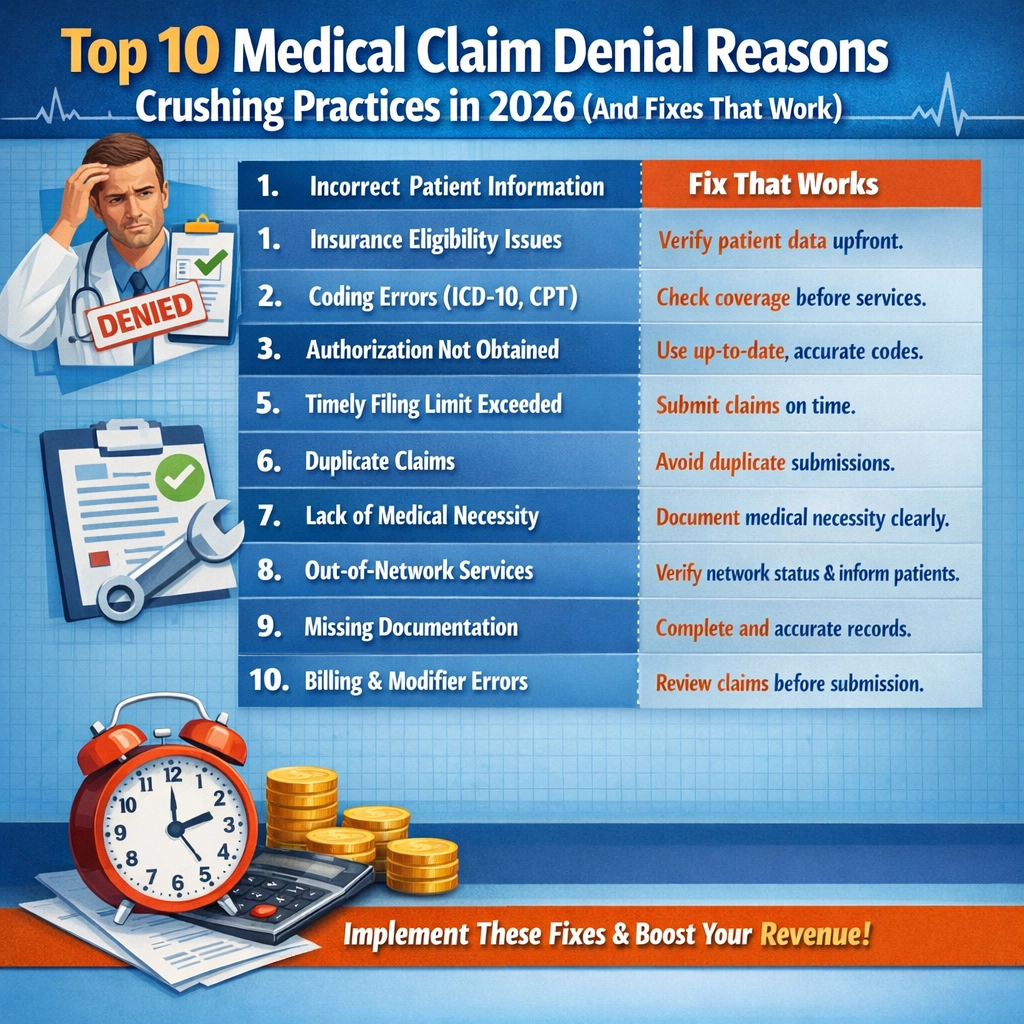
- Eligibility & Coverage Verification Failures Still the #1 trigger. Issues include inactive coverage, wrong demographics, unverified benefits, or stealth mid-year changes. Recent trends show eligibility volatility spiking denials, especially in Medicaid and marketplace plans.
- Missing or Invalid Prior Authorization Prior auth denials remain rampant as requirements expand. Even approved services can deny if the auth number is missing, expired, or mismatched—often 30-35% of total denials in affected categories.
- Coding Errors & Incorrect/Outdated Codes Mismatches in CPT, ICD-10 specificity, or modifiers (e.g., 25, 59) trigger automatic rejections. 2026 updates added hundreds of new codes, creating “specificity traps” where general codes are no longer valid.
- Insufficient or Incomplete Documentation / Medical Necessity Gaps Payer NLP scans notes for alignment with codes; vague or missing clinical justification leads to CO-50 or similar denials. This is rising with AI-driven scrutiny on high-cost claims.
- Incorrect or Missing Modifiers Modifiers are frequently flagged when they don’t support the service (e.g., bilateral procedures without -50). This is a top recurring issue in multi-specialty practices.
- Duplicate Claims or Services System errors or resubmissions flagged as duplicates cause unnecessary denials, especially when timing overlaps.
- Timely Filing Limits Exceeded Strict payer windows (often 90-180 days) are enforced rigorously; delays from internal bottlenecks lead to permanent losses.
- Coordination of Benefits (COB) Errors Primary/secondary payer mismatches or unaddressed other coverage cause rejections.
- Patient Responsibility / High-Deductible Issues Failure to collect or bill patient portions upfront results in downstream denials or bad debt.
- Provider Credentialing / Enrollment Issues Outdated enrollment or non-participating status with payers triggers full denials, particularly for new providers or after network changes.
These top reasons account for the vast majority of preventable denials in 2026.
Proven Fixes: How to Slash These Denials Today
Implement this layered approach to prevention—used by RevGen clients to achieve first-pass acceptance rates of 90-95%:
- Automate Real-Time Eligibility & Prior Auth Checks Integrate verification at scheduling/check-in. Flag high-risk services early and track auth status with reminders. This alone eliminates 40-50% of eligibility/prior auth denials.
- Invest in Advanced Claim Scrubbing & AI Prediction Use tools that apply payer-specific edits and predict denial risk pre-submission. Catch coding, modifier, and documentation gaps before claims go out.
- Strengthen Documentation & CDI Processes Embed prompts in your EHR for specificity and medical necessity. Train coders on 2026 updates quarterly and conduct regular audits.
- Build a Denial Management Engine Categorize every denial by code, payer, and root cause. Use templated appeals with strong supporting documentation. Analyze monthly trends to fix systemic issues (e.g., recurring modifier errors).
- Outsource for Expertise & Scale Dedicated RCM teams stay ahead of payer rule changes, reducing administrative burden and boosting recovery rates on appeals.
One recent client example: After implementing these steps, a mid-sized practice reduced denials from 18% to 7% in four months, recovering $38,000+ in previously lost revenue from just one quarter’s claims.
The Bottom Line
In 2026, denials aren’t a “billing department problem”—they’re a practice-wide revenue threat. Ignoring them means accepting 10-19% leakage as normal. But with targeted prevention, you can reclaim significant dollars without adding patients or staff.
Don’t guess where your biggest leaks are. Schedule your free RevGen Billing Audit now. We review 50-100 recent claims, deliver a detailed 5-7 page report highlighting your exact denial patterns, missed revenue, and quick-win fixes—within 48 hours. No cost, no commitment.
Go to revgenbilling.com or email revgenbilling@gmail.com to book yours today. Let’s turn those top 10 denial reasons into paid claims.
Which of these denial reasons hits your practice hardest right now? Drop it in the comments—we’ll share a tailored tip for each.