
Latest posts
-

Best Medical Billing Companies in Virginia (2026 Guide) Published August 11, 2026 · Last updated August 11, 2026 · 14 min read A practice manager in Henrico County called me a couple of years back. Her group had $38,000 sitting past 120 days and nobody could tell her why. We pulled the aging report together…
-
Signs Your Medical Billing Company Is Underperforming

Last updated: August 2026 · Reading time: 12 minutes Your medical billing company is underperforming if three or more of these are true right now: One of these is a bad month. Three is a pattern. Five is a structural failure, and every week you wait, more of your money crosses the 90-day line where it stops being collectible. But…
-
CPT 2027 Maternity Care Coding Changes Explained: The End of Global Billing

The CPT 2027 maternity care coding changes replace traditional global obstetric billing with discrete, service-level codes. Effective January 1, 2027, providers must separately report antepartum care, labor management, delivery, and postpartum care. This granular approach aims to accurately reflect modern, team-based obstetric care and ensure fair reimbursement for complex or fragmented services. The landscape of…
-
How 2026 AI CPT Codes Are Transforming Medical Coding Roles

Navigating the AI Revolution: 2026 CPT Codes and the Future of Coding The 2026 CPT code updates introduce specific Category I and III codes for AI-driven services, such as coronary plaque assessment and burn wound imaging. This shifts the medical coder’s role from manual data entry to “AI Auditing,” requiring expertise in natural language processing…
-
Best ICD-10 Code for Type 2 Diabetes: Clinical Expert Tips
Mastering the ICD-10 Code for Type 2 Diabetes: A Real-World Guide Quick Answer: The primary ICD-10 code for type 2 diabetes is E11.9 for patients without complications. However, coding for type 2 diabetes (T2DM) requires more than just one number; you must select specific subcodes (like E11.22 for kidney disease or E11.40 for neuropathy) to…
-
Mastering the ICD-10 Code for Farxiga: A Practical 2026 Guide

The most common ICD-10 code for Farxiga (dapagliflozin) is E11.9 for Type 2 diabetes without complications. However, because Farxiga is also FDA-approved for heart failure and kidney disease, you may need I50.9 (Heart Failure, unspecified) or N18.31 (Chronic Kidney Disease, stage 3a) depending on the patient’s primary diagnosis. For accurate billing in 2026, always pair…
-
Master Gynecology CPT & ICD 10 Codes: A 2026 Practical Guide

Quick Answer: Accurate gynecologic billing requires pairing the correct evaluation, preventive, or surgical procedure code (CPT 58100–58571 and 99202–99459) with the most specific diagnostic code (ICD-10 Z01.411–Z01.419 for routine exams or R10.21–R10.24 for localized pelvic pain). Mastery of these codes, proper use of modifiers like -25, and strict compliance prevent claim denials and optimize practice…
-
What is the process of medical billing from start to finish
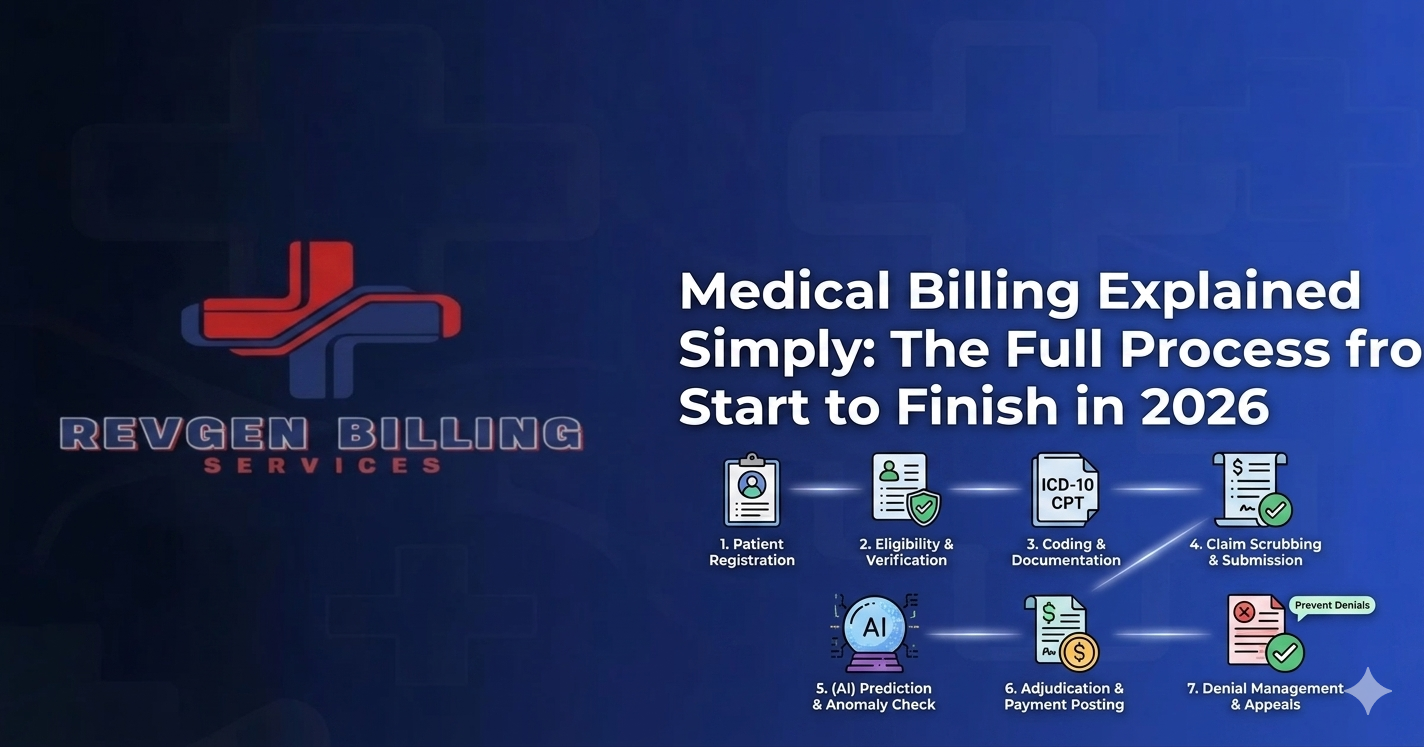
Medical Billing Explained Simply: The Full Process from Start to Finish in 2026 Medical billing is the behind-the-scenes system that helps doctors, clinics, and hospitals get paid for the care they provide. It turns a patient visit into money that keeps healthcare running. If you’ve ever received a confusing medical bill or wondered why payments…
-
AI in Revenue Cycle Management 2026: Tools That Predict & Prevent Denials Before They Happen

Practices actively protect and grow revenue in 2026 by deploying AI in revenue cycle management that predicts denials before claims leave the office. Payers use advanced AI to deny claims faster than ever, pushing denial rates to 12-19% industry-wide. Forward-thinking practices counter this with their own AI tools—achieving 20-37% fewer denials, 13-25% higher first-pass acceptance,…
-
The 2026 Denial Playbook: Appeal Templates & Strategies That Recover 70%+ of Denied Claims

Practices actively recover substantial revenue in 2026 by executing a structured denial playbook instead of accepting losses. With denial rates averaging 12-19% across private payers and Medicare Advantage, and fewer than 1% of patients appealing marketplace denials, providers who master appeals gain a massive edge. Well-crafted, payer-specific appeals overturn 45-70% of challenges when supported by…