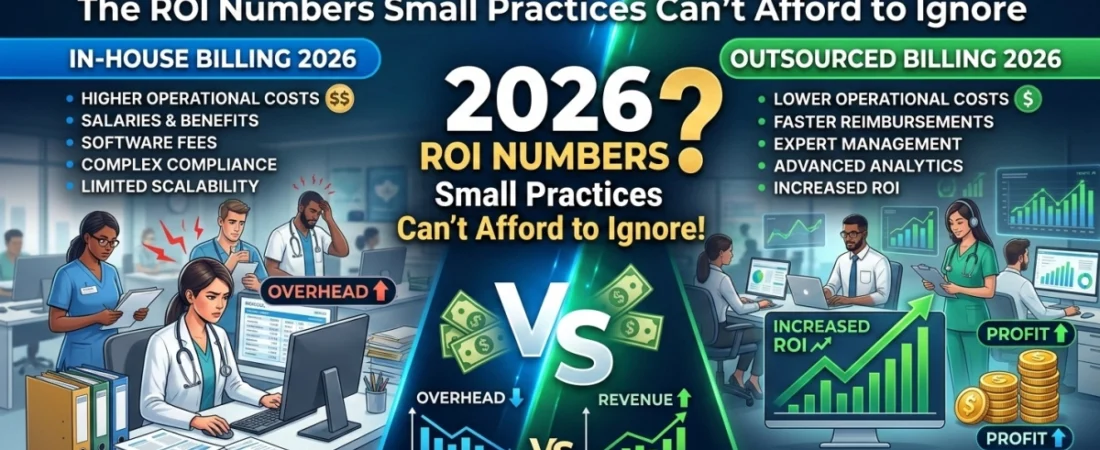
In 2026, small-to-mid-sized healthcare practices (1-10 providers) face mounting pressure on their revenue cycle. Rising claim denial rates (now averaging 10-19% industry-wide), persistent prior authorization delays (with 7-14 day standard turnaround under CMS rules), staffing shortages, and the ongoing shift to value-based care models are forcing owners to scrutinize every dollar in overhead.
The big question: Should you keep billing in-house (your own staff handling claims, denials, appeals, and compliance) or outsource to a specialized RCM partner? Recent data shows the answer is clear for most small practices: outsourcing delivers 3-5x higher ROI through faster collections, lower denial rates, and reduced administrative burden.
At RevGen Billing, we help practices transition seamlessly and deliver measurable revenue gains. This in-depth comparison uses 2026 benchmarks to show the true costs, risks, and returns—so you can make an informed decision before more revenue slips away.
The 2026 Reality: Why In-House Billing Is Breaking Practices
In-house teams struggle with:
- High Staff Costs & Turnover — Average medical biller salary: $45,000–$65,000 + benefits/taxes = $60K–$90K per full-time employee. Turnover exceeds 30-40% annually in RCM roles.
- Rising Denial & A/R Challenges — Practices report 15-20% initial denial rates; rework costs $25–$181 per claim.
- Compliance & Tech Gaps — Keeping up with 2026 CPT/ICD updates, payer rule changes, and CMS interoperability mandates requires constant training and software investment ($10K–$50K/year for EHR/PM upgrades + scrubbing tools).
- Time Drain — Owners/managers spend 10-20 hours/week overseeing billing instead of patient care or growth.
Result: In-house billing often costs 8-12% of practice revenue in overhead while achieving only 85-90% first-pass acceptance and 45-60 day average A/R.
Outsourced Medical Billing in 2026: The Modern Standard
Specialized RCM firms like RevGen leverage scale, technology, and expertise:
- Dedicated Teams — Certified coders/billers focused solely on your specialty, with payer-specific knowledge.
- Advanced Tech Stack — AI-driven claim scrubbing, predictive denial tools, automated PA tracking, and real-time dashboards—reducing manual work by 50-70%.
- Performance Guarantees — Many offer 90-95%+ first-pass rates, <30-day A/R, and contingency-based appeals recovery.
- Compliance Assurance — Built-in HIPAA, 2026 CPT mastery, and audit defense.
Key 2026 stats favor outsourcing:
- Outsourced practices achieve 5-15% higher net collections.
- Denial reduction of 40-60% post-transition.
- Staff savings: Eliminate 1-3 FTEs while gaining better results.
Head-to-Head ROI Comparison: In-House vs. Outsourced (Small Practice Example)
Assume a typical small practice: $1.5M–$3M annual collections, 5 providers, multi-specialty.
| Metric | In-House Billing | Outsourced to RevGen (Typical) | Annual Difference (Savings/Gain) |
|---|---|---|---|
| Overhead Cost (Staff + Software + Training) | $120K–$250K | 5-8% of collections (~$75K–$240K, often performance-based) | +$45K–$100K savings |
| First-Pass Acceptance Rate | 85-90% | 92-97% | +$30K–$90K in faster cash flow |
| Denial Rate | 12-20% | 5-8% | +$45K–$120K recovered revenue |
| Average A/R Days | 45-65 | 25-35 | Improved cash flow by 20-40 days |
| Net Revenue Impact | Baseline | +3-8% overall collections | +$45K–$240K/year |
| Total Estimated Annual ROI | – | 300-500% on fees | $100K–$300K+ net benefit |
These numbers align with 2026 industry reports: Outsourced RCM often yields $30K–$80K+ in annual savings/recovery for small practices, with payback in 3-6 months.
Hidden Costs of In-House Billing You Can’t Ignore in 2026
- Opportunity Cost — Time spent on billing = less focus on patient acquisition, marketing, or expansion.
- Burnout & Errors — Understaffed teams lead to more mistakes, higher denials, and compliance risks (e.g., HIPAA fines up to $50K+ per violation).
- Scalability Limits — Growth means hiring/training more staff—exponential cost increases.
- Tech Lag — Without enterprise tools, you miss AI denial prediction and automated PA (now standard in top outsourced models).
When Outsourcing Makes the Most Sense in 2026
- Denial rates >10% or A/R >45 days
- Staff handling billing + other duties (hybrid inefficiency)
- Specialty with complex coding (e.g., ortho, cardiology, oncology)
- Practice growth plans or recent payer changes
- Desire to reclaim owner time for clinical/strategic focus
Real RevGen Client Results in 2026
A 6-provider family practice switched to RevGen after in-house denials hit 18%. Post-transition:
- Denials dropped to 6%
- A/R reduced from 58 to 32 days
- Net collections up 7.2% ($68K+ in Year 1)
- Owner regained 15+ hours/week for patient care and expansion
Make the Smart Move: Calculate Your Exact ROI
Don’t rely on averages—see your practice’s specific numbers.
Schedule your free RevGen Billing Audit today. We analyze 50-100 recent claims, deliver a personalized 5-7 page report in 48 hours showing:
- Current in-house leaks (denials, underpayments, A/R drag)
- Projected outsourced savings/ROI
- Quick fixes + full transition roadmap
No cost. No obligation. Pure value.
Visit revgenbilling.com or email info@revgenbilling.com now. In 2026, the gap between in-house and outsourced is wider than ever—don’t let your practice fall behind.
Are you currently in-house or outsourced? What’s your biggest RCM pain point? Share below—we’ll provide a tailored insight.