
Medical Billing Explained Simply: The Full Process from Start to Finish in 2026
Medical billing is the behind-the-scenes system that helps doctors, clinics, and hospitals get paid for the care they provide. It turns a patient visit into money that keeps healthcare running. If you’ve ever received a confusing medical bill or wondered why payments take so long, this process is why.
In 2026, medical billing has become more digital and complex. There are hundreds of new codes for things like remote patient monitoring, telehealth, and even AI-assisted services. Medicare rules keep updating, and insurance companies use smarter systems to review claims. One small mistake can lead to delayed payments or denials.
This guide walks you through the entire medical billing process step by step — from the moment a patient schedules an appointment until the final payment is collected. It’s based on how the “revenue cycle” generally works in most practices.
Step 1: Patient Pre-Registration and Scheduling
Everything starts before the patient even walks in the door.
When someone books an appointment (by phone, online, or app), the front desk collects basic information:
- Full name, date of birth, address, and contact details
- Insurance information (policy number, group ID, payer name)
- Reason for the visit
This early data collection helps prevent problems later. Many offices now use online portals for patients to fill out forms themselves, saving time.
Step 2: Insurance Eligibility and Benefits Verification
Next comes one of the most important checks: confirming the patient’s insurance is active and what it actually covers.
Staff (or automated systems) verify:
- Is the insurance policy still valid?
- What services are covered for this visit?
- How much is the deductible, copay, or coinsurance?
- Does the procedure need prior authorization (pre-approval)?
In 2026, many practices check this electronically through payer portals or clearinghouses. It’s best done close to the appointment date because insurance can change (especially at the start of a new year). Missing this step often leads to claim denials.
Tip: Patients should bring their insurance card and photo ID to confirm details at check-in.
Step 3: Patient Check-In and the Actual Visit (Encounter)
The patient arrives. Staff update any changed information, collect any upfront copay if known, and have the patient sign consent forms.
During the visit, the doctor or provider:
- Examines the patient
- Discusses symptoms, history, and treatment
- Performs any procedures or orders tests
Everything must be carefully documented in the electronic health record (EHR). Good notes are crucial because they become the proof for what gets billed later.
Step 4: Charge Capture (Creating the Superbill)
Right after the visit, all services provided are recorded. This might be called a “superbill” — a list of what happened during the appointment.
Examples of charges include:
- Office visit level
- Lab tests
- Procedures
- Supplies used
In modern systems, this often happens automatically through the EHR, but staff still review it for accuracy.
Step 5: Medical Coding
This is often called the most technical part of the process.
Coders (or the billing team) review the doctor’s notes and assign standardized codes:
- ICD-10 codes: For the diagnosis (why the patient was seen — e.g., high blood pressure, injury).
- CPT codes: For the procedures and services performed (what the doctor did). In 2026, there are 288 new CPT codes, many for digital health, remote monitoring (RPM), remote therapeutic monitoring (RTM), telehealth expansions, and advanced procedures like leg revascularization.
- HCPCS codes: For supplies, drugs, or certain Medicare services.
For Evaluation & Management (E/M) office visits, coders choose the level based on medical decision-making (complexity) or total time spent on the date of service. Documentation must clearly support the chosen level — vague notes can lead to lower payments or audits.
Accurate coding is critical. Wrong codes are one of the top reasons for claim denials in 2026.
Step 6: Claim Scrubbing and Submission
Before sending anything, the claim goes through “scrubbing” — a review for errors like missing information, mismatched codes, or invalid patient details.
Once clean, the claim is submitted electronically (usually through a clearinghouse) to the insurance company (payer). Electronic submission is fast and standard in 2026.
Step 7: Payer Adjudication (Insurance Review)
The insurance company receives the claim and reviews it. This process is called adjudication.
They check:
- Was the service covered?
- Was prior authorization obtained if needed?
- Are the codes correct and documented properly?
The payer then sends back an Explanation of Benefits (EOB) or Electronic Remittance Advice (ERA) showing what they will pay, what the patient owes, and any denials or adjustments.
This step can take days to weeks, depending on the payer.
Step 8: Payment Posting
When payment arrives (by check, electronic transfer, or direct deposit), the billing team posts it to the patient’s account.
They apply:
- Insurance payment
- Any contractual adjustments (discounts agreed with the insurer)
- Remaining balance to the patient
Step 9: Denial Management and Appeals
Not every claim gets paid on the first try. Denials happen for many reasons — missing authorization, coding errors, or medical necessity questions.
The team investigates each denial, corrects issues if possible, and resubmits the claim or files an appeal with more documentation. In 2026, payers (especially Medicare Advantage plans) are stricter, so denial management takes more time and effort.
Good practices track common denial reasons and fix them at earlier steps to improve “first-pass” success rates.
Step 10: Patient Billing and Collections
After insurance pays its share, the patient gets billed for their responsibility (deductible, copay, coinsurance, or non-covered services).
Practices send statements and offer payment plans or online portals. Many now use text-to-pay or card-on-file options for easier collections.
If the patient doesn’t pay, the account moves to collections (after following fair practices and regulations).
Step 11: Accounts Receivable (AR) Follow-Up and Reporting
The final part of the cycle involves following up on any unpaid claims and analyzing performance.
Practices look at reports like:
- Days in AR (how long it takes to get paid on average)
- Denial rates
- Collection percentages
This data helps improve the whole process over time.
What’s New or Challenging in Medical Billing in 2026?
- CPT Updates: 288 new codes, 84 deletions, and 46 revisions. Many focus on digital health, AI tools in diagnostics, remote care, and more detailed procedure coding (e.g., for prostate biopsies or lower extremity revascularization).
- E/M Documentation: Stronger emphasis on clear medical decision-making and total time. Providers need better notes to avoid downcoding or audits.
- Medicare Changes: The Part B deductible is around $283. There are updates to telehealth rules, Advanced Primary Care Management (APCM), and care coordination billing.
- Technology & Denials: More practices use AI-assisted tools for coding and scrubbing, but payer-side AI is also flagging more claims. Prior authorization reform is ongoing to reduce delays.
- Patient Responsibility: With higher deductibles, collecting from patients has become a bigger part of revenue.
These changes mean practices must update their software, train staff regularly, and stay on top of rules from the American Medical Association (AMA) and Centers for Medicare & Medicaid Services (CMS).
Simple Text-Based Flowchart of the Process
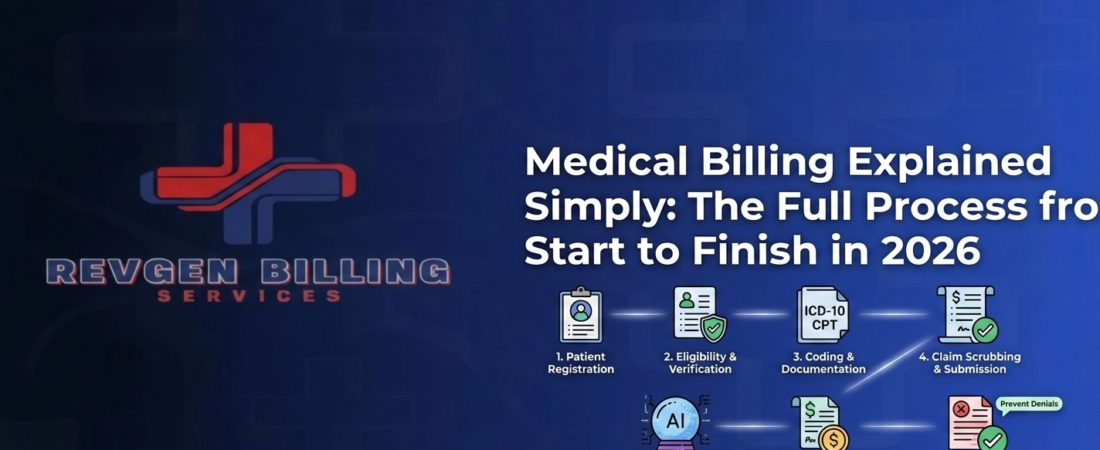
Registration & Scheduling → Insurance Verification → Patient Visit & Documentation → Charge Capture → Medical Coding → Claim Scrubbing & Submission → Payer Review (Adjudication) → Payment Posting → Denial Management (if needed) → Patient Billing & Collections → Reporting & Analysis
Why This Process Matters
A smooth medical billing cycle means doctors get paid faster, patients face fewer surprises, and clinics can focus more on care instead of paperwork. Poor billing leads to cash flow problems, staff stress, and sometimes higher costs passed to patients.
For patients: Always check your Explanation of Benefits and question anything that doesn’t match your visit. Verify insurance early and keep good records.
For practices: Invest in good EHR/billing software, train on 2026 code changes, and review denials regularly.
Final Thoughts
The medical billing process is a long chain — break one link and payments slow down or stop. In 2026, success comes from accuracy, technology, and staying updated with new codes and rules.
This is a general overview based on standard practices. Rules can vary by location, payer, and specialty. For specific advice, consult a certified medical biller, your practice management team, or official resources like CMS.gov or the AMA.
Understanding how it works helps everyone — whether you’re a healthcare worker, patient, or just curious about the system.