
Find Out Where Your Practice Is Actually Losing Revenue — Free
A no-cost, no-obligation review of your billing performance: first-pass clean claim rate, denial categories, A/R aging, coding patterns, fee-schedule currency — plus two checks almost no other audit includes: a 2026→2027 charge-master currency check and your MIPS position against the 75-point threshold.
- 8 audit areas — from clean claim rate to credentialing, each with your baseline number and the specific fix
- ~20 minutes of your time across two short touches — the analysis happens on our side
- 24–48 hour findings, delivered as a written report you keep whether or not we ever work together
- Your current biller is never contacted — the audit runs on reports you already have
- Metric definitions included — every number comes with its formula, so you can verify it in your own system
What a Free Billing Audit Is — In One Paragraph
Most practices have no objective baseline for their billing. They know roughly what they’re collecting — they don’t know what they should be collecting. The gap between those two numbers is almost always larger than the practice manager expected, and it accumulates silently: undercoded visits, denials nobody worked, payments posted wrong, contracts not renegotiated in years, codes on the charge master that were deleted last January. The audit is where the silence ends — every gap becomes visible, and once it’s visible, it’s fixable.
The 8 Areas We Examine — Six You’d Expect, Two Nobody Else Runs
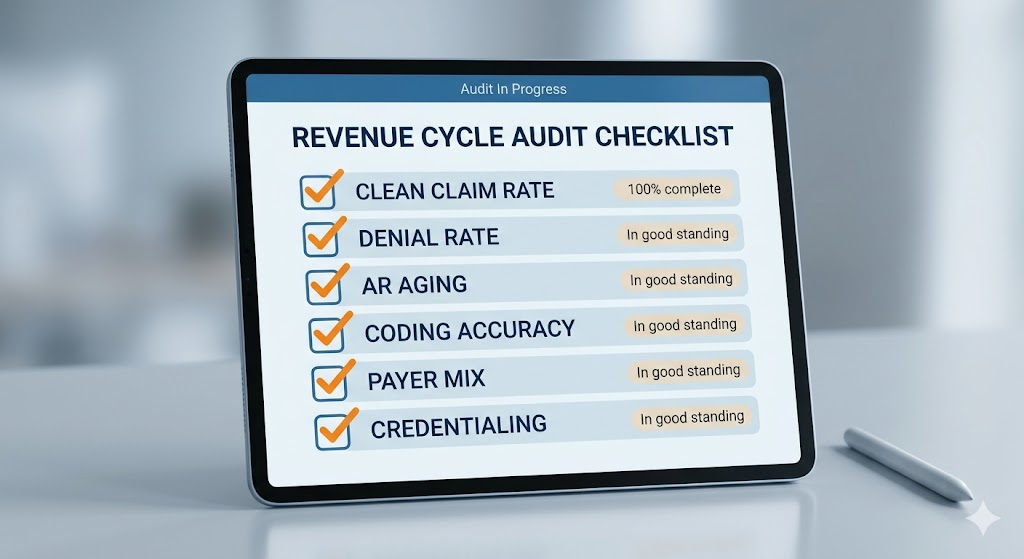
1. Clean claim rate — first-pass
What percentage of claims are accepted on first submission? Below 90% signals an upstream problem in documentation, coding, eligibility, or claim prep. We establish the baseline and name the claim categories dragging it down.
2. Denials by category & payer
An auth denial from Medicare and a modifier denial from a commercial plan need completely different responses. The audit maps your denial pattern so effort goes where the recoverable money is — most practices find a majority of denials cluster in two or three fixable categories.
3. A/R aging distribution
How much of your outstanding A/R is current, 30–60, 60–90, and 90+ — and how much of the 90+ bucket is still recoverable versus already past timely filing. Aging A/R isn’t just slow cash; past the filing limit it becomes a write-off.
4. Coding accuracy patterns
Systematic undercoding, overcoding risk, missed modifier opportunities (the -25 gap is the classic), diagnosis specificity gaps. Not error-catching — pattern-finding that changes the practice’s economics when corrected prospectively.
5. Payer mix & fee schedules
Are you contracted with the right payers for your population, and are your fee schedules current — or still sitting on terms from years ago while reimbursement benchmarks moved? Underpaid-by-contract is the quietest leak there is.
6. Credentialing status
Every provider checked for active enrollments across payers, with renewals coming due in the next 90 days flagged. One lapsed enrollment can create a wave of denials from a single payer.
7. Charge-master currency check new
Your actual billed codes reviewed against the 2026 code changes (restructured PCI family, revised E/M and add-on rules, the J-code switches) and the January 1, 2027 wave — including the maternity global-period deletion for OB/GYN practices. Deleted codes on a charge master are automatic denials; new codes you’re not billing are silent underbilling. This check finds both before January does.
8. MIPS eligibility & position new
Whether each clinician is in, out, or opt-in for the current performance year — and a rough scoring position against the 75-point threshold, including whether the Promoting Interoperability 180-day window is already in trouble. Details on the MIPS reporting page.
Every number comes with its formula
First-pass clean claim rate = claims accepted on first submission ÷ claims submitted — measured before rework. Net collection rate = payments ÷ (charges − contractual adjustments). Days in A/R = total A/R ÷ average daily charges. Definitions matter: a “clean claim rate” measured after rework is not a first-pass rate, and a billing company that won’t define its own headline numbers is publishing marketing, not measurement. Everything in your audit report is reproducible from your own system.
What Practices Typically Discover — The Patterns We See
Every practice is different, but across audits the same findings recur — these are the patterns, not promises about your practice:
Denials that recur unchecked
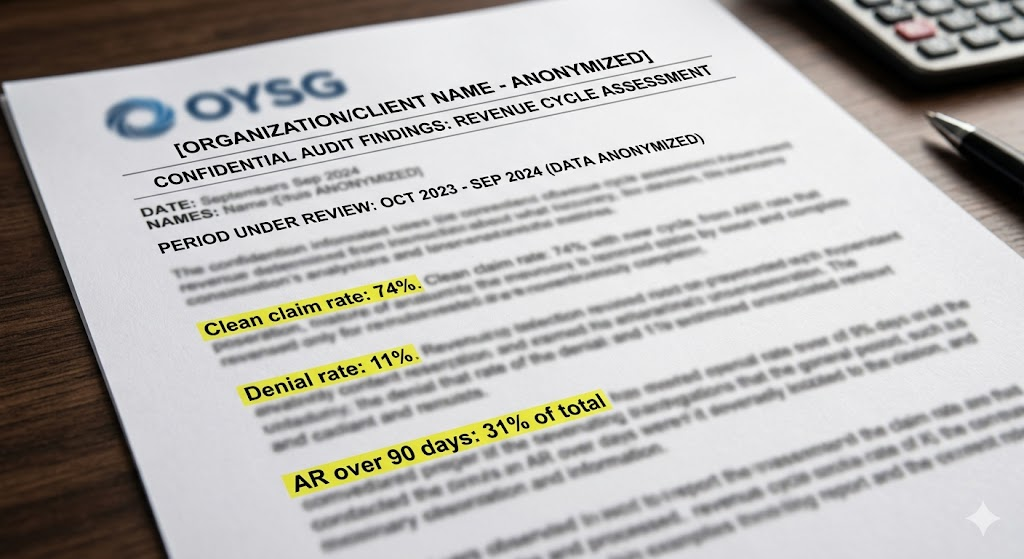
Denial rates of 8–15% on specific payer–procedure combinations that have repeated for months without anyone working the pattern, only the individual claims.
Aged A/R that’s still money
25–35% of outstanding A/R sitting past 90 days — a large share of it still recoverable with systematic follow-up, if it’s worked before timely filing closes the door.
Systematic undercoding
Documentation supporting a higher level of service than what’s submitted — especially on E/M visits in primary care and internal medicine. The most common reaction to a first audit is surprise at the coding gap, not the denial rate.
Missed modifier opportunities
Dates of service where a separately billable E/M was performed alongside a procedure but modifier -25 was never appended — revenue left on the table inside claims that were otherwise clean.
Credentialing near-lapses
Providers who joined in the last 18 months with enrollments that lapsed or nearly lapsed during the transition — usually discovered only after a payer’s denials start.
Stale fee schedules
Contracts not reviewed in years, now paying meaningfully below current benchmarks — invisible because the payments keep arriving, just smaller than they should be.
How the Audit Works — Five Steps, About 20 Minutes of Your Time
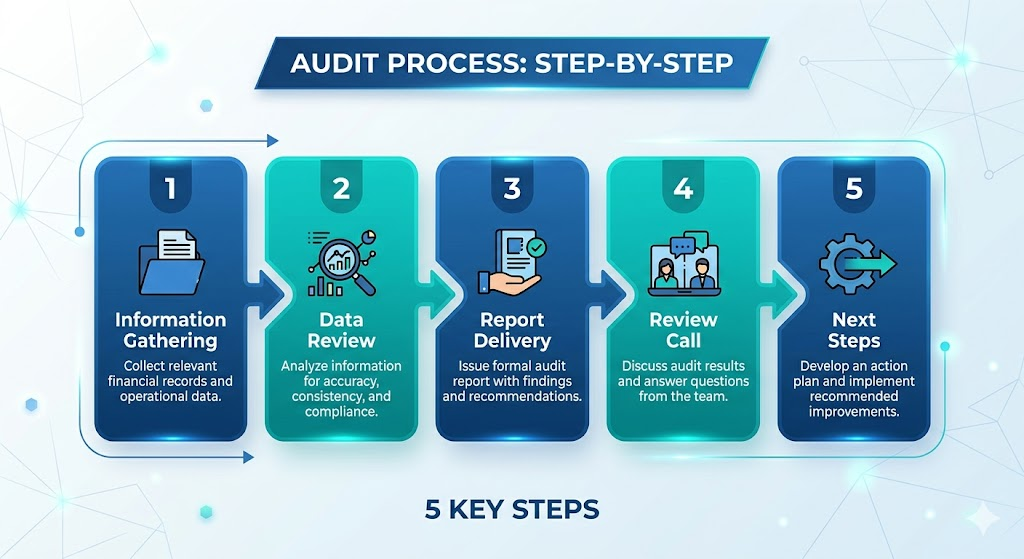
Information gathering. Specialty, provider count, EHR system, current billing setup (in-house or third-party), approximate monthly volume — and what reports to pull.
You send three reports from your practice management system or current biller: A/R aging summary, denial summary by payer and reason, and roughly three months of remits. A charge master or fee schedule export deepens the currency check. That’s it.
Analysis on our side. Certified billing analysts work the eight areas and produce a written findings report: baselines, benchmarks, and the specific gaps.
Review call. A RevGen consultant walks you through the findings and the recovery opportunity specific to your practice — and answers every question.
No-obligation next step. If RevGen is a fit, the onboarding conversation starts. If not, you keep the report and use it with any billing partner — or with your own team.
🔒 Your data, handled properly
Reports are handled under a HIPAA Business Associate Agreement, used solely for your audit, and not retained beyond the engagement unless you become a client. The audit can even start de-identified — A/R and denial analyses work on totals.
🤐 Your current biller never knows
The audit runs entirely on reports you already have access to. Your current billing company is never contacted — many audited practices are mid-contract and deciding whether to renew.
🖥️ Whatever system you run
Guidance on what to pull is specific to your platform — we work inside 40+ EHR/PM systems, so “where’s the A/R aging report” has a real answer, not a generic one.
Why this quarter
Three Calendars Make Timing Matter
Timely filing
Every payer’s filing limit is quietly converting your oldest A/R into write-offs. Money the audit finds now is still recoverable; money found next quarter may not be.
January 1, 2027
The next code-change wave lands: CPT 2027 and the maternity global-period deletion. Charge masters that aren’t checked before January turn stale codes into denials overnight.
MIPS performance year
Improvement Activities and MVP registration deadlines arrive in the fall; the current year’s score sets 2028 payments. The audit shows your position while there’s still time to move it.
Specialty-Specific Findings
Audit findings get sharper with specialty context — each of these pages shows the code sets, payer rules, and 2026–2027 changes the audit checks against for that specialty:
Frequently Asked Questions
Is the RevGen billing audit truly free with no strings attached?
What does the audit examine?
How much of my time does the audit take?
What reports do I need to prepare?
What if my current billing company finds out about the audit?
Is my practice data safe?
What is the charge-master currency check?
Does the audit include MIPS?
How long does it take to get audit results?
Can the audit tell whether my coding is compliant?
What happens if I don’t switch to RevGen after the audit?
Why does timing matter for a billing audit?
Your Findings Are 48 Hours Away
Three reports, twenty minutes of your time, zero cost — and a written baseline of exactly where your revenue stands, including the January 2027 exposure check. Whether you ever work with RevGen or not, you should know these numbers.
Book Your Free Audit: Info@revgenbilling.com✔ No Cost · ✔ No Obligation · ✔ Your current biller is never contacted · ✔ You keep the report