

Best Medical Billing Companies in Virginia (2026 Guide)
Published August 11, 2026 · Last updated August 11, 2026 · 14 min read
A practice manager in Henrico County called me a couple of years back. Her group had $38,000 sitting past 120 days and nobody could tell her why.
We pulled the aging report together on a screen share. Took about twenty minutes to find it.
Their biller had been sending Medicare Part B claims for two Northern Virginia satellite locations to the same place as everything else. Wrong Medicare contractor. The claims weren’t denied exactly. They were just sitting in a queue that nobody was watching.
That’s not an unusual story. And it’s the reason I get annoyed at most “top 10 billing companies in Virginia” articles. They’ll tell you ten company names. They won’t tell you the one thing about Virginia that quietly eats your money.
So this guide does both. Companies first, because that’s what you came for. Then the stuff that actually decides whether you get paid.
Quick answer
There is no single best medical billing company in Virginia. The right one depends on your specialty, your payer mix, and your size.
Expect to pay 4% to 10% of collections. Expect credentialing with Virginia Medicaid to take four to six months. And before you sign anything, confirm the company knows two things: how Cardinal Care’s five MCOs work, and that Virginia is split between two Medicare contractors.
If they can’t answer both, keep looking. Address doesn’t matter. Payer knowledge does.
What’s in this guide
- The companies worth a call
- What makes billing in Virginia different
- Do you need a company based in Virginia?
- What it actually costs
- 12 questions to ask before you sign
- The numbers your biller should report
- Red flags
- How to switch without losing cash
- FAQ
Best medical billing companies in Virginia for 2026
How this list was put together
Fair warning up front. I run a billing company. RevGen is on this list, at the bottom, and I’ve told you exactly what we are and aren’t.
Every other “best of” list you’ll read today was also written by a billing company that put itself at number one. At least three of the top-ranking Virginia lists right now do exactly that. One of them ranks itself first while admitting in the same paragraph that it’s headquartered in Texas.
So here’s my rule for this list: I only included companies I could verify actually serve Virginia practices, and I said something honest about each one, including the ones that compete with me.
What I weighted: verifiable Virginia presence or Virginia payer experience, specialty depth, transparency about pricing, and whether real providers can be found reviewing them somewhere I don’t control.
The companies
1. Nova Medical Billing (Chantilly, VA). Small shop, heavily certified leadership, works mostly with solo and small group practices. Flexible on pricing models — flat fee, per claim, or percentage. Good pick if you want a human who picks up the phone.
2. HMS USA Inc. (Reston, VA). One of the few on this list with a real Northern Virginia office. Broad service menu including credentialing and RPM billing. Larger operation, so ask who specifically handles your account.
3. 1st Choice Medical Billing (Portsmouth, VA). Thirty-plus years in Hampton Roads. Independent, multi-specialty, low-key. They aren’t going to win an SEO contest, which is sometimes a good sign.
4. Old Town Medical Billing and Credentialing (Manassas, VA). Fifteen-plus years with mental health practices specifically. Straightforward pricing. Narrow focus, and that’s the point.
5. Atlantea Medical Billing (Virginia Beach). Founded in 2000, deeply rooted in Hampton Roads. Strong local reputation with providers who want somebody in the same time zone and the same traffic.
6. Avosina Healthcare Solutions (VA). Combines RCM with practice analytics. Better fit for groups that want dashboards and trend data rather than just claim pushing.
7. FC Billing LLC. Strong on behavioral health and Spravato billing, which is a genuinely painful niche. If you’re a psychiatry or mental health practice, they belong on your shortlist.
8. Medusind. Large national operation with real payer relationships and analytics. Best fit for mid-size to large groups. Smaller practices sometimes feel like a ticket number.
9. Coronis Health. Enterprise RCM. Right answer if you’re a hospital-affiliated department. Overkill for a five-provider clinic.
10. Medical Billers and Coders (MBC). I’ll give them credit — their specialty pages show real Virginia knowledge, including the Northern Virginia Medicare carve-out. They understand this state better than most national firms.
A note on the names you’ll see elsewhere. Tebra (formerly Kareo), AdvancedMD, DrChrono, and CareCloud show up on a lot of Virginia lists. Those are mainly software platforms that offer billing services attached. That’s a different product. Know which one you’re buying.
At a glance
| Company | Based in VA? | Best fit | Watch for |
|---|---|---|---|
| Nova Medical Billing | Yes — Chantilly | Solo & small groups | Limited capacity for large groups |
| HMS USA | Yes — Reston | Multi-service needs | Ask who owns your account |
| 1st Choice | Yes — Portsmouth | Hampton Roads independents | Low digital footprint |
| Old Town Billing | Yes — Manassas | Mental health | Narrow specialty range |
| Atlantea | Yes — Virginia Beach | Hampton Roads providers | Smaller team |
| Avosina | Yes | Analytics-driven groups | Less behavioral health depth |
| FC Billing | Regional | Behavioral health, Spravato | Specialty-focused |
| Medusind | No | Mid to large groups | Less personal for small practices |
| Coronis Health | No | Health-system departments | Enterprise pricing |
| MBC | No | Specialty-specific billing | Large offshore component |
| RevGen Billing | No — remote | Small/mid practices wanting hands-on RCM | Founded 2022, newer company |
What makes medical billing in Virginia different
This is the part other lists skip. It’s also the part that decides your cash flow.
Virginia is split between two Medicare contractors
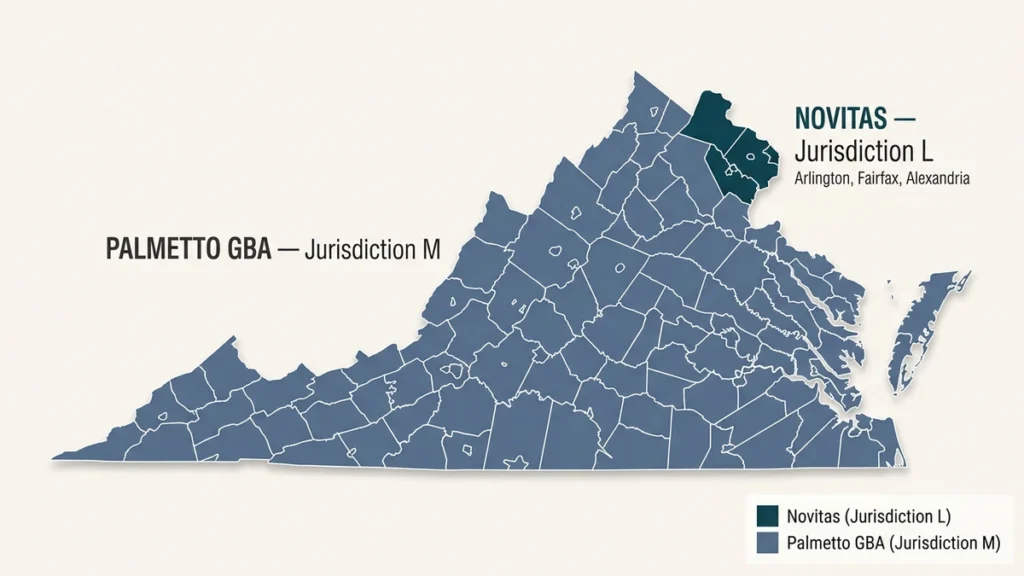
Almost every state has one Medicare Administrative Contractor. Virginia has two.
Most of the Commonwealth bills Medicare Part B to Palmetto GBA, which handles Jurisdiction M.
But three places don’t. Arlington County, Fairfax County, and the City of Alexandria are carved out into the Washington D.C. metro jurisdiction and bill Part B to Novitas Solutions under Jurisdiction L.
Different contractor. Different portal. Different local coverage determinations. Different appeals process.
Why this matters more than it sounds. If your group has a main office in Richmond and a satellite in Fairfax, you are billing Medicare to two separate contractors. A biller who doesn’t know this will route everything to one of them. Those claims don’t always bounce loudly. Sometimes they just sit.
Ask any billing company you’re interviewing: “Which MAC do you use for our Fairfax location?” If they pause, you have your answer.
Cardinal Care and the five MCOs

Virginia Medicaid runs under one brand now: Cardinal Care.
As of July 1, 2025, it operates through five managed care organizations:
- Aetna Better Health of Virginia
- Anthem HealthKeepers Plus
- Humana Healthy Horizons in Virginia
- Sentara Community Plan
- UnitedHealthcare Community Plan of Virginia
Notice who isn’t there. Molina exited Virginia Medicaid on July 1, 2025. Humana took its place.
Here’s a small test you can run right now. Open any “2026 medical billing companies in Virginia” article and search the page for “Molina.” Several of the top-ranking ones still list it as an active Virginia Medicaid plan. That tells you how much of that content was actually researched this year.
The practical fallout: every former Molina patient moved to a new plan. If your front desk isn’t re-verifying eligibility at every visit, you’re submitting to a plan that no longer covers that patient. Those denials are avoidable and they’re still happening a year later.
One more thing on timely filing. Virginia Medicaid fee-for-service gives you 12 months. The MCOs are much tighter — generally 180 days, and some plans run shorter.[5] Same patient population, wildly different deadlines. Confirm the current limit in your contract with each plan.
Anthem has three separate credentialing tracks
This one catches almost everyone.
Anthem in Virginia is not one credentialing relationship. It’s three:
- Anthem Blue Cross Blue Shield commercial
- Anthem HealthKeepers Plus (Cardinal Care Medicaid)
- Anthem HealthKeepers Medicare Advantage
Being credentialed with the first does not get you the second or third. I’ve watched practices see patients for two months assuming they were in-network, then eat every claim.
And for Medicaid there’s a two-step order. You enroll with DMAS through the PRSS system first. Then you contract separately with each MCO. Contracting with an MCO does not enroll you with DMAS.
Realistic timeline: DMAS PRSS runs 30 to 60 days. Each MCO adds another 60 to 90 days after that. Budget four to six months and you won’t be shocked.
The 40-day rule almost nobody uses
This is my favorite thing about billing in Virginia, and I’ve met maybe a dozen practice managers who knew about it.
Under Code of Virginia § 38.2-3407.15, carriers operating in Virginia have to follow specific rules on your claims:
- 40 days to pay a clean claim. Not “process.” Pay.
- 30 days to tell you a claim has a defect. If they don’t flag it in that window, they generally can’t refuse the claim later on that basis.
- 12 months maximum on most retroactive denials and recoupments — with 30 days written notice specifying which claims and why.
- Interest accrues automatically on late payments. You are not supposed to have to ask.
Read that clawback rule again. When a payer sends a letter demanding money back on a claim from 2023, that letter is not automatically valid. There are exceptions — fraud, or another carrier being responsible — but the 12-month limit is real.
Most practices just pay. That’s money left on the table every single year.
Try this. Pull your aging report and filter for clean claims sitting past 45 days with a Virginia-regulated commercial carrier. Then reference § 38.2-3407.15 in your follow-up. In my experience the tone of the conversation changes quickly.
Note: this statute applies to carriers regulated by Virginia. It does not cover self-funded employer plans governed by ERISA, and it doesn’t cover Medicare. Know which bucket the claim is in before you cite it.
Balance billing and arbitration — who actually wins
Virginia’s balance billing law took effect January 1, 2021. If you’re out-of-network for emergency services, or providing surgical or ancillary services at an in-network facility, you can’t bill the patient beyond their in-network cost share. You negotiate with the carrier, and if that fails, you go to arbitration.
The State Corporation Commission publishes who wins. Here’s what the data shows, and it’s genuinely surprising:
| Specialty | Provider win rate |
|---|---|
| Anesthesia | 95% |
| Plastic & reconstructive surgery | 66% |
| Neurology | 64% |
| Emergency medicine | 32% |
| All specialties, since 2021 | 40% |
If you’re an anesthesia group in Virginia and you’re accepting the carrier’s first offer, you are almost certainly leaving money behind. Providers in that specialty win nineteen out of twenty arbitrations.
If you’re emergency medicine, the math runs the other way and you should pick your fights carefully.
The deadlines are tight, and this is where practices lose by default: you have 30 days from the carrier’s payment notification to dispute, then 30 days of good faith negotiation, then 10 days to file for arbitration with the SCC.[2] Miss a window and the decision is made for you.
Do you actually need a company based in Virginia?
I’ll answer this straight, and I’ll disclose my bias again: RevGen is not based in Virginia. We work remotely with practices here.
So take my answer with that in mind, and then check it against your own logic.
Being in Virginia does not make a biller good at Virginia. I have seen local companies route Fairfax claims to Palmetto. I have seen local companies still submitting to Molina in 2026. A Richmond zip code doesn’t teach anyone the MAC split.
What matters is whether the team works your payers every day. Do they know Anthem’s three tracks? Have they done a DMAS PRSS enrollment recently? Can they tell you Sentara’s timely filing limit without looking it up?
Where local does genuinely help: if you want someone to physically sit in your office during a transition, if you’re a large hospital-affiliated group with in-person governance, or if you personally just work better face to face. Those are real reasons and I won’t argue with them.
Where local doesn’t matter at all: claim submission, denial work, A/R follow-up, payment posting, credentialing paperwork. All of it happens in payer portals. The portal doesn’t know where you’re sitting.
My honest suggestion: don’t filter your shortlist by geography. Filter by payer knowledge. Then ask the local ones the same hard questions you’d ask a remote team.
What medical billing actually costs in Virginia
Nobody publishes their rate card, so here’s the range from across the industry in 2026.
| Model | Typical range | Best for | Watch out for |
|---|---|---|---|
| Percentage of collections | 4%–10% | Most practices | Is it net or gross? Huge difference. |
| Per claim | $4–$8 | Low volume, simple claims | Denial follow-up often costs extra |
| Flat monthly | $500–$2,500 | Predictable volume | Rate rises as you grow |
| Hybrid | Small base + ~3–4% | Growing practices | Read what the base actually covers |
Where you land depends mostly on complexity. High-volume, simple specialties like primary care sit near 4% to 6%. Behavioral health, pain management, and surgical specialties with heavy prior authorization sit closer to 7% to 10%. Solo practices pay more because low volume costs the same to service.
The fees that don’t appear in the pitch
- Setup and implementation — $2,000 to $10,000
- Clearinghouse fees — $0.25 to $0.50 per claim
- Patient statements — $0.50 to $2.00 each
- Credentialing — often per provider, per payer
- Early termination penalties
- Software or portal access fees
Ask for the complete fee schedule in writing. Every line. A company that won’t put it in an email is telling you something.
In-house versus outsourced, with real math
Take a practice collecting $2.5 million a year.
In-house: two billing FTEs at roughly $95,000 combined, plus about $28,500 in benefits and payroll tax, $12,000 in software, $6,000 in clearinghouse fees, $9,000 in statements, $3,000 in training, plus management time and office overhead. That’s roughly $176,500, or about 7.1% of collections.
Outsourced at 6%: $150,000 in fees plus around $5,000 of internal oversight. About $155,000, or 6.2%.
The percentage gap is modest. The real difference is elsewhere. When your in-house biller takes two weeks off, claims stop going out. When she resigns, you lose institutional knowledge and eat a hiring cycle. That risk doesn’t show up in a spreadsheet until the month it happens.
Fair counterpoint, since I promised honesty: an excellent in-house biller who knows your specialty cold is hard to beat. If you have one, keep her, pay her well, and get her cross-trained backup. Outsourcing is not automatically better. It’s better when your current setup is fragile or underperforming.
12 questions to ask before you sign

Copy these into an email. The answers will separate the shortlist fast.
- Which Virginia payers do you work every day? Listen for specific plan names, not “all major payers.”
- Which MAC handles Part B for each of my locations? The test question.
- Who exactly works my account, and where do they sit? Named people. Not “a dedicated team.”
- What’s your first-pass clean claim rate, measured how? Everyone says 98%. Ask how they calculate it and over what period.
- Show me a sample monthly report. If it’s a one-page summary with no A/R aging buckets, that’s your future visibility.
- What’s the full fee schedule, every line item? In writing.
- Percentage of net or gross collections? On $2.5M this is a five-figure difference.
- Who owns the data if we part ways? The answer must be you. Get it in the contract.
- What are the termination terms? Look for notice period and any penalty. Sixty days is reasonable. A year is a trap.
- Will you sign a BAA, and where is PHI stored and accessed? Especially important with offshore teams. Not disqualifying — just get it documented.
- Do you handle credentialing, and what’s included? DMAS PRSS and MCO contracting are separate work streams.
- Can I talk to two current clients in my specialty? Not testimonials on a website. Phone numbers.
The numbers your biller should report every month
If you get one page a month that says “we collected $X,” you don’t have reporting. You have a receipt.
| Metric | Good | Excellent | Problem |
|---|---|---|---|
| First-pass clean claim rate | 93–95% | 97%+ | Below 90% |
| Initial denial rate | Under 8% | Under 5% | Over 10% |
| Net collection rate | 90%+ | 95–98% | Under 88% |
| Days in A/R | Under 40 | Under 35 | Over 50 |
| A/R over 90 days | Under 15% | Under 10% | Over 25% |
| Appeal win rate | 50%+ | 70%+ | Under 30% |
For context on where the bar sits: the industry-wide initial denial rate hit 11.8% in 2024, up from 10.2% in 2020, according to Kodiak Solutions data reported through HFMA.[9] And Experian Health’s 2025 State of Claims survey found 41% of providers now see more than one in ten claims denied — up from 30% in 2022.
Rising denials are not just your practice. But they are still your revenue.
The number that should actually worry you is what happens after the denial. MGMA data indicates 50% to 65% of denied claims are never reworked at all, and reworking one costs somewhere between $25 and $181 in staff time.
Think about that ratio. More than half of denials just get abandoned. That’s not a claims problem, it’s a staffing and follow-through problem — and it’s the single biggest reason practices switch billers.
One more that surprises people: Medicaid inpatient claims carry roughly a 44% initial denial rate, the highest of any payer category, while traditional Medicare sits near 5%. If you serve a heavy Cardinal Care population, your denial rate is going to look worse than a colleague’s, and that may be normal rather than failure. Benchmark against your own payer mix, not somebody else’s.
Red flags
Things I’d walk away from:
- “We guarantee a 98% clean claim rate” with no definition. Everybody claims this number. Almost nobody defines it.
- No free audit. Any competent company will look at your A/R aging before quoting. If they price you blind, they’re guessing.
- Vague about staffing location. Offshore is fine and common. Hiding it isn’t.
- A contract longer than a year with no exit.
- They can’t name your payers. Ask about Sentara Community Plan specifically and watch what happens.
- Reporting they “customize later.” Ask for the sample report now.
- Pressure to sign this week. Your A/R has been aging for months. Another two weeks won’t change anything.
How to switch without losing a month of cash
Most practices lose money in the transition, not in the decision. Here’s the sequence that works.
- Read your termination clause first. Before you talk to anyone new. Know your notice period.
- Export everything. Full A/R aging, patient ledgers, payer contracts, fee schedule, credentialing records. Get it while you’re still a customer in good standing.
- Decide who works the old A/R. This is the step people skip. The outgoing company has zero incentive to chase old claims. Either negotiate a tail period in writing, or pay the new company to take it over.
- Run parallel for two to four weeks. New claims go to the new team while the old team closes out. Costs a little. Saves a lot.
- Move credentialing and EFT last. Payer portal access, ERA enrollment, and EFT routing take longer than anyone expects. Start early, cut over late.
- Set a 90-day checkpoint with specific numbers you agreed on before signing. Days in A/R, denial rate, A/R over 90. Write them into the contract if you can.
RevGen Billing — remote RCM for Virginia practices
Straight disclosure: we are not based in Virginia. We work with Virginia practices remotely, and I said earlier that address matters less than payer knowledge. That applies to us too — so hold us to it.
What we do: full-cycle billing across 20+ specialties, eligibility verification, coding, denial management with root-cause tracking, A/R recovery, and credentialing support including DMAS PRSS and Cardinal Care MCO contracting. Certified billers, HIPAA-compliant workflows, signed BAA, transparent KPI reporting.
What we’re not: we’re a 2022 company with 20+ people. If you need an enterprise vendor with a thousand seats and a Richmond office, one of the companies above is a better call, and I’d rather tell you that now.
Start with the free A/R audit. We look at your aging report, tell you where the money is stuck, and you decide what to do with that. No obligation either way. Email info@revgenbilling.com.
Frequently asked questions
Which medical billing company is best in Virginia?
There isn’t one. A solo behavioral health provider in Roanoke and a twelve-provider orthopedic group in Fairfax need completely different partners. Match on specialty and payer mix first, then compare price. Anyone who names a single “best” company without asking about your practice is selling, not advising.
How much do medical billing companies charge in Virginia?
Between 4% and 10% of collections for percentage pricing. Simple, high-volume specialties land near 4% to 6%. Complex specialties with heavy prior authorization land nearer 7% to 10%. Per-claim runs $4 to $8. Always confirm whether the percentage is on net or gross collections.
Do I need a billing company physically located in Virginia?
No. What matters is Virginia payer knowledge — Cardinal Care’s five MCOs, the Palmetto GBA and Novitas split for Medicare Part B, and DMAS enrollment. A company down the road that doesn’t know those things will cost you more than a remote team that does. Ask about the rules, not the address.
How fast does an insurance company have to pay a claim in Virginia?
Under Code of Virginia § 38.2-3407.15, a carrier must pay a clean claim within 40 days. It also has only 30 days to notify you of a defect that prevents the claim from being clean. This applies to Virginia-regulated carriers, not to self-funded ERISA plans or Medicare.
How long does Virginia Medicaid credentialing take?
Plan for four to six months. DMAS PRSS enrollment typically takes 30 to 60 days. Each Cardinal Care MCO adds another 60 to 90 days after PRSS approval, and you contract with each plan separately.
What is a good clean claim rate and denial rate?
Target a first-pass clean claim rate of 95% or better and a denial rate under 5%. The industry-wide initial denial rate reached 11.8% in 2024, so anything consistently above 10% means something upstream is broken — usually eligibility, authorization, or coding.
Can a payer take back money they already paid me?
In Virginia, generally only within 12 months of the original payment, and the carrier must give 30 days written notice naming the specific claims and the reason. Exceptions exist for fraud and for cases where another carrier was responsible. Don’t assume a clawback letter is automatically valid.
Is it cheaper to outsource or keep billing in-house?
For most small and mid-sized practices, yes — once you count salary, benefits, software, clearinghouse fees, and vacation coverage. In-house often runs 10% to 14% of collections all-in. But a strong in-house biller who knows your specialty is genuinely hard to beat. The question is whether your current setup is fragile, not whether outsourcing is better in the abstract.
What should I ask before hiring a billing company?
Who specifically works your account, what your A/R over 90 days looks like after a free audit, the complete fee schedule in writing, whether you own your data, the termination terms, and which Virginia payers they touch daily. The twelve questions above cover the rest.
Disclaimer
This article is educational content about medical billing and revenue cycle operations. It is not medical advice, legal advice, tax advice, or financial advice, and it does not create a professional relationship of any kind.
Nothing here addresses clinical care or patient treatment decisions.
Billing regulations, payer policies, timely filing limits, and Medicaid managed care contracts change frequently. Information was accurate to the best of our knowledge as of August 11, 2026. Statutory references are summaries, not the full text of the law — always read the current statute and consult a qualified healthcare attorney or compliance professional before acting on any regulatory point. Verify current payer requirements directly with each payer.
Coding and reimbursement decisions should be made in consultation with a certified coder or compliance officer familiar with your specialty and documentation.
About the author
Oliver Hayes, CPB — Director of Revenue Cycle Operations at RevGen Billing.
“Oliver Hayes has spent 14 years in physician revenue cycle, including six years managing A/R for multi-site practices across Virginia, Maryland and North Carolina. She is an AAPC Certified Professional Biller and has personally handled DMAS PRSS enrollments and Cardinal Care MCO contracting for more than 40 providers. She writes about denial prevention and payer behavior.“
Connect: [REPLACE: real LinkedIn URL]
Reviewed by
Oliver Hayes, CPC, CPMA — Certified Professional Coder and Certified Professional Medical Auditor.
This article’s coding, compliance and regulatory statements were reviewed for accuracy on 08/11/2026.
Sources and references
- Code of Virginia § 38.2-3407.15, Ethics and fairness in carrier business practices. Virginia Legislative Information System. law.lis.virginia.gov
- Code of Virginia § 38.2-3445.01, Balance billing for certain services; prohibited, and § 38.2-3445.02 (arbitration). law.lis.virginia.gov
- Centers for Medicare & Medicaid Services, Medicare Administrative Contractors (MACs) — Provider Portals by State. Jurisdiction M (Palmetto GBA) excludes Part B for Arlington and Fairfax counties and the City of Alexandria, which fall under Jurisdiction L (Novitas Solutions). cms.gov
- Virginia Department of Medical Assistance Services, Cardinal Care Managed Care Provider Implementation FAQ. dmas.virginia.gov
- Payer timely filing limits and Anthem credentialing tracks: verify current terms directly in your executed contract with each plan. Summarized from published Virginia provider guidance, 2026.
- Virginia DMAS Provider Services Solution (PRSS) enrollment requirements. dmas.virginia.gov
- Virginia State Corporation Commission, Bureau of Insurance, Health Insurance Balance Billing Arbitration Annual Report (2025) and Balance Billing and Arbitration Annual Report (2025). rga.lis.virginia.gov
- Medical billing outsourcing pricing ranges and in-house cost comparison, 2026 industry pricing surveys. Figures are representative ranges, not quotes.
- Kodiak Solutions hospital revenue cycle data, reported via HFMA — initial denial rate of 11.8% in 2024, up from 10.2% in 2020.
- Experian Health, 2025 State of Claims — 41% of providers report denial rates above 10%, up from 30% in 2022. experian.com
- Medical Group Management Association (MGMA) — 50% to 65% of denied claims are never reworked; rework cost of $25 to $181 per claim.
- Kodiak Solutions inpatient denial data by payer, 2025 — Medicaid inpatient initial denial rate approximately 44%; traditional Medicare approximately 5%.
- Vabson B, Hicks AL, Chernew ME. “Medicare Advantage Denies 17 Percent Of Initial Claims; Most Denials Are Reversed.” Health Affairs. healthaffairs.org
Major Independent Cities
- Virginia Beach
- Chesapeake
- Norfolk
- Richmond
- Newport News
- Alexandria
- Hampton
- Roanoke
- Portsmouth
- Suffolk
Other Independent Cities
- Bristol
- Buena Vista
- Charlottesville
- Colonial Heights
- Covington
- Danville
- Emporia
- Fairfax
- Falls Church
- Franklin
- Fredericksburg
- Galax
- Harrisonburg
- Hopewell
- Lexington
- Lynchburg
- Manassas
- Manassas Park
- Martinsville
- Norton
- Petersburg
- Poquoson
- Radford
- Salem
- Staunton
- Waynesboro
- Williamsburg
- Winchester